


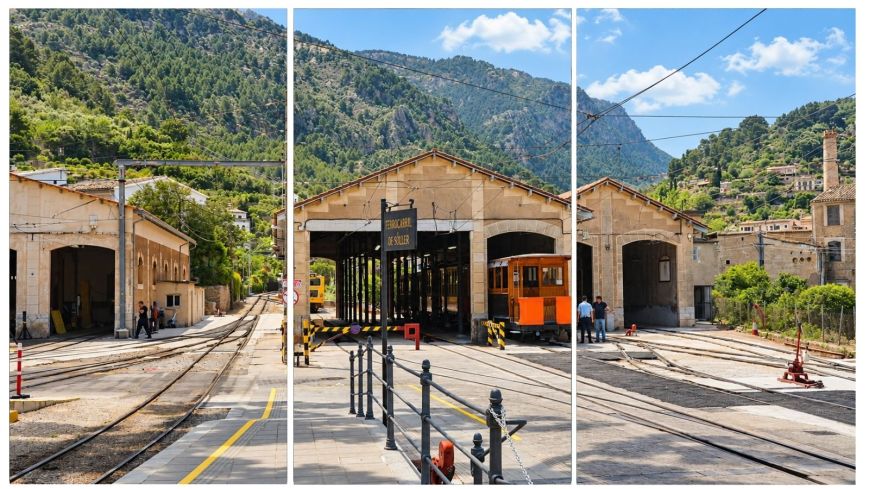
There was a time when getting to Sóller was quite an adventure.
Nowadays, all you need to do is hop on the historic train in Palma and let the scenery roll by outside the window. But just over a century ago, reaching the Sóller Valley meant braving the mountains of the Serra de Tramuntana along narrow, treacherous paths.
The fertile and prosperous valley relied largely on its orange groves and commercial activity. However, the very same geography that made Sóller such a special place also kept it virtually cut off from the rest of Mallorca.
Until one day, someone imagined that the mountains could be crossed.
A valley cut off from the rest of the island
At the start of the 20th century, Sóller needed a more efficient link with Palma and the rest of Mallorca. Travellers had to cross the Coll de Sóller via a difficult road, whilst transporting goods was slow and costly.
This need was particularly acute for an economy based on agriculture and trade. The citrus fruits grown in the valley needed to reach other markets and the port more easily.
The idea of building a railway began to take shape in the late 19th century. One of its main proponents was Jerónimo Estades, a local from Sóller, a businessman and provincial councillor, who championed the creation of a railway line connecting Sóller with Palma.
But there was one obvious problem: the railway would have to cut through the mountains.
A project that seemed impossible
Work began on 3 June 1907, with construction proceeding simultaneously from both Palma and Sóller.
The Serra de Tramuntana was not going to make it easy.
The route required the construction of tunnels, cuttings and viaducts to navigate extremely rugged terrain. The greatest challenge was the Serra d’Alfàbia, which had to be crossed via a 2,856-metre tunnel.
For years, men and machines worked in conditions very different from those of today. There were no advanced technological resources or modern machinery capable of automatically overcoming the difficulties posed by the terrain. They had to literally cut their way through the mountain.
And little by little, the train began to draw closer to Sóller.
The arrival of the María Luisa locomotive
On 19 August 1911, the small locomotive María Luisa reached the Pujol d’en Banya viewpoint.
Shortly afterwards, on 30 September 1911, the first construction train arrived in Sóller.
On 7 October of that same year, a very special unofficial inauguration took place. The María Luisa, accompanied by a saloon carriage, took some of the people who had made the project possible to Sóller, including Jerónimo Estades and Pedro Garau.
The grand opening would have to wait a few months.
16 April 1912: Sóller is connected
Finally, on 16 April 1912, the Sóller Railway was officially opened. Locomotives No. 1, ‘Sóller’, and No. 2, ‘Palma’, led the inaugural train. That day marked the beginning of a new era for the valley.
At that time, the train was not a tourist attraction. It was something far more important: a new gateway to Sóller. It made it much easier to transport people and goods and connected the valley with Palma and the rest of the island.
The geographical distance remained the same. But the distance separating Sóller from the world had changed forever.
From trade to travel
A year after the railway’s opening, another event took place that would complete the transformation of the valley’s connections. On 4 October 1913, the electric tram line between Sóller and Port de Sóller was opened. The line ran for 4.868 kilometres and linked the village with its port.
Thus was born a route that still forms part of the experience for many travellers today: Palma → Sóller → Port de Sóller.
What began as a necessity for the economy and transport would, over time, become one of Mallorca’s most iconic railway routes.
The train also switched to electric power
In 1929, the Sóller Railway took another important step: on 14 July, electric traction was inaugurated between Palma and Sóller.
Since then, the train has continued to evolve without losing what made it special. Today, more than a century later, its carriages and route allow passengers to experience a journey that retains much of the essence of that first connection.
And perhaps that is one of the reasons why boarding the train remains more than just a journey from one place to another.
A journey that forms part of Sóller’s history
As the train leaves Palma, the landscape gradually changes. The city is left behind. The mountains come into view. The train heads into the Serra de Tramuntana and passes through the tunnels that form part of the line’s history.
Then comes one of the most special moments of the journey: the Viaducte dels Cinc Ponts, with its five stone arches, before the Sóller valley comes into view amongst the orange and olive trees. And that’s when you realise why this train is so special. Because it doesn’t just take you to Sóller.
The train tells the story of how Sóller came to be the town we know today.
More than a century later
The Sóller Railway has been running the route between Palma and Sóller since 1912, and the tram between Sóller and El Port since 1913. The railway line is currently 27.3 kilometres long and the tram line 4.9 kilometres.
What began as a project to end the isolation of a valley ended up becoming an inseparable part of its identity.
Perhaps that is why, when the train finally pulls into Sóller station, the feeling is not exactly that of having arrived.
It is more like having travelled back in time to discover the valley in a different way.